
Forget pages. The real intranet clean-up challenge is SharePoint files

The single biggest source of unmanaged content on intranets isn't Content pages or News articles - it's SharePoint Files. And by a significant margin.
When intranet teams think about content clean-up, they typically focus on pages. But new SWOOP Analytics benchmarking research suggests they may be overlooking a much bigger problem.
Across the SharePoint environments analysed, organisations were sitting on an average of more than 65,000 files that hadn't been touched in more than a year - far exceeding the volume of neglected Content pages or News articles.
In the past, that might have been little more than a housekeeping issue. Today, it's becoming an AI issue.
Generative AI can surface information from the content it has access to. If outdated, duplicated or abandoned files remain in the environment, they don't just create clutter - they can influence the answers employees receive.
At that point, cleaning up content stops being a governance exercise and becomes an AI readiness imperative.
The hidden content problem
Most intranet governance activities focus on Content pages. That makes sense. Content pages often contain critical policies, procedures, departmental information and knowledge resources that employees rely upon every day.
Our latest benchmarking data shows that Content pages are generally the most actively maintained type of intranet content. Yet even then, more than half had not been modified in more than a year. If these pages are intended to be the authoritative source of information, that's a concerning statistic in itself.
But Content pages are not the biggest clean-up challenge.
When we compared intranet Content pages, News articles and SharePoint files, a very different picture emerged. Content pages typically receive ongoing attention. News articles naturally lose relevance over time. SharePoint files, however, are often published once and then forgotten.
And because files vastly outnumber every other content type, they create the largest concentration of unmanaged content across the digital workplace.
On average, organisations in our benchmarking sample had:
Around 1,000 Content pages untouched for more than a year
Almost 2,000 News articles untouched for more than a year
More than 65,000 SharePoint files untouched for more than a year
That's where the real clutter lives.
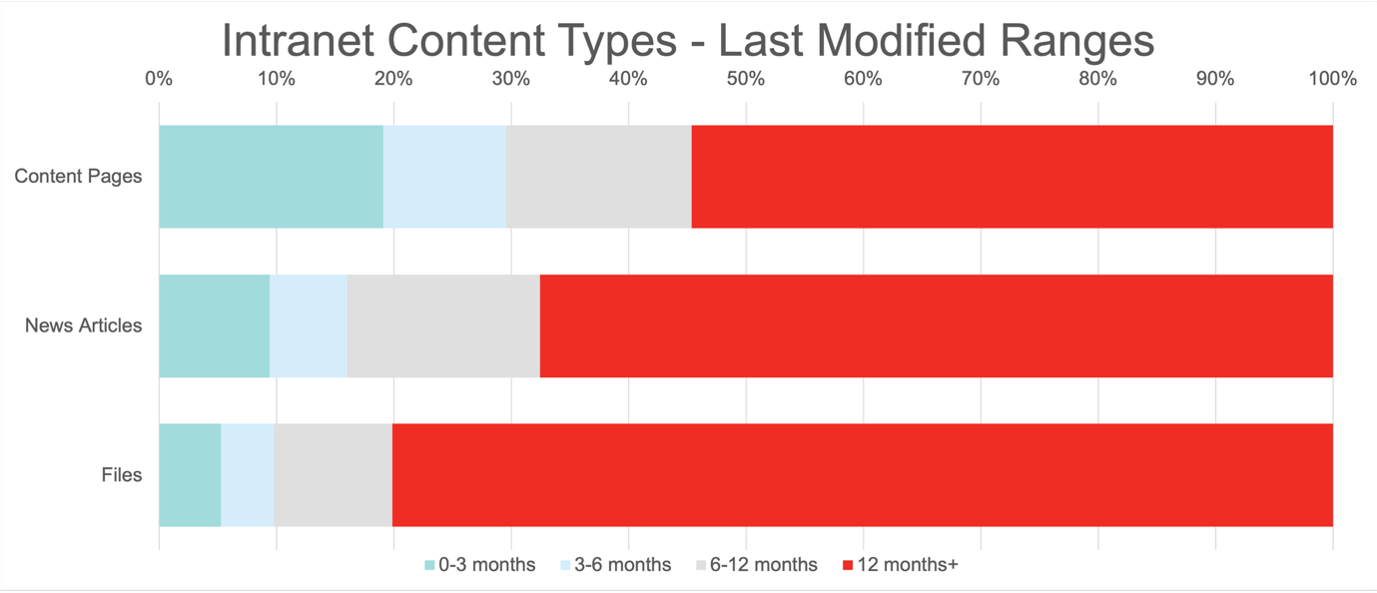
Intranet content types and modified date ranges in SWOOP Analytics’ study.
If employees are struggling to find information, or search results feel noisy and irrelevant, forgotten files are often the first place to investigate.
Why AI changes the equation
For many years, organisations could tolerate a certain level of content clutter.
Traditional search still required employees to review results, assess relevance and decide which information to trust. AI changes that equation.
Generative AI tools surface answers directly from the content they can access. If outdated policies, duplicate documents, abandoned project files or obsolete templates remain available, those sources can potentially influence the response. Old content is no longer simply clutter. It becomes risk.
This is why some of the organisations seeing the greatest value from AI are also those with the strongest content governance practices.
They understand who owns content. They review information regularly. They archive outdated material. They monitor growth and actively manage information quality. In short, they treat content as an asset rather than a storage problem.
The problem is getting bigger
One of the most striking findings from our benchmarking research is the rate at which intranet content continues to grow.
Across organisations, SharePoint content volumes increased by about 20% per year. At that pace, an intranet can effectively double in size every four years.
If managing information feels difficult today, imagine dealing with twice as much content in just a few years' time.
Yet many organisations still lack formal review schedules, archiving policies or ownership frameworks. Publishing content is easy. Removing, reviewing and governing it is much harder.
Three places to start
The prospect of cleaning up thousands, or even tens of thousands, of content items can feel overwhelming. The good news is that organisations don't need to tackle everything at once.
Based on our benchmarking findings, there are three high-impact places to begin.
1. Start with SharePoint files
Files represent the largest source of unmanaged content in most organisations. Focus on:
Documents untouched for more than 12 months
Duplicate files
Completed project material
Outdated templates
Redundant reports
Further below we’ll outline how you can use SWOOP Analytics to identify content that isn’t being used and/or has not been updated for a long time.
2. Archive ageing news content
News articles typically have a short lifespan, yet many organisations leave every article searchable forever.
Ask yourself whether employees truly need to see announcements from several years ago in search results. Where content must be retained for compliance purposes, archiving may be a better option than leaving it active and searchable.
The goal isn't necessarily removal. It's reducing noise.
3. Review high-traffic pages
One surprising finding from the data was that many older content pages continue to attract significant traffic. That may sound encouraging, but it also suggests employees may be relying on information that hasn't been reviewed for years.
Prioritise pages that combine:
High traffic
High business importance
Long periods without modification
These often represent the greatest governance risk.
Measure before you clean
Successful governance programs are almost always data-led.
Telling executives that the intranet "feels cluttered" rarely creates urgency. Showing that most content hasn't been updated for more than a year is far more compelling. Demonstrating that AI tools may have access to tens of thousands of obsolete files is even more powerful.
Before starting a clean-up initiative, establish a baseline:
How many pages exist?
How many files exist?
How much content is more than a year old?
What content has no owner?
Which areas are growing fastest?
Once you can quantify the problem, governance becomes much easier to prioritise and improve. This is where SWOOP Analytics can help. Use SWOOP Analytics' Summary Details dashboard to identify how many Content pages, News articles and SharePoint files exist on your intranet, and how many of them have not been modified for months or years.
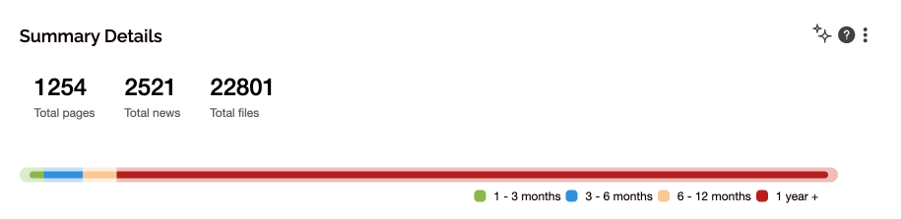
A screenshot of the Summary Details in SWOOP Analytics for SharePoint intranet.
The challenge with most clean-up projects is knowing where to start. You can use the data export feature in SWOOP Analytics for SharePoint intranet to export a list of all content on your intranet (Content pages, News articles and SharePoint files) and that includes the date when it was last modified and, of course, which site the content belongs to. That makes it super easy to target your efforts.
Think progress, not perfection
One of the biggest mistakes intranet teams make is treating governance as a massive project that requires months of planning.
It doesn't have to.
Start small.
Archive one obsolete site.
Review 10 high-traffic pages.
Identify content without owners.
Create a quarterly content review process.
Every piece of content you retire makes the intranet easier to navigate, easier to trust and easier for AI to understand. The goal isn't to create a perfect intranet. It's to stop the haystack growing faster than employees can find the needle.
And if there is one lesson from the data, it's this: if you're not actively managing content growth, your intranet isn't standing still. It's getting more complicated every single day.
The best time to start cleaning up was probably a few years ago. Second best is to start on Monday!
