
Boehringer Ingelheim - Governing a global intranet with 2,000 editors

From 60,000 pages to a healthy, sustainable intranet

Robert Thieme, Head of IT M&S Corporate Affairs, Boehringer Ingelheim.
When Boehringer Ingelheim migrated from SharePoint on-premise to SharePoint Online, it inherited a familiar problem, at extraordinary scale.
The global biopharmaceutical company’s global intranet had grown to almost 60,000 pages, created over many years by thousands of editors. Much of it was outdated, little of it was actively used, and search had become increasingly unreliable.
Robert Thieme, Head of IT M&S Corporate Affairs at Boehringer Ingelheim, remembers people were complaining that intranet search didn’t work.
“But it wasn’t really a search problem,” he said.
“It was a content quality problem.”
Fast forward to today and Boehringer Ingelheim boasts the top-ranked intranet in the EMEA region in SWOOP Analytics’ 2026 benchmarking study, despite it also being the largest intranet in the analysis.
What makes Boehringer Ingelheim’s intranet so healthy?
The answer is a deliberate approach to governance built around editors, data, and continuous support.
The scale: 2,000 editors and 34,000 intranet pages
Boehringer Ingelheim operates a federated intranet model with around 2,000 editors responsible for content across the organisation. It also has 36,000 daily unique users.
That number of editors wasn’t a deliberate design choice but an inherited reality.
“We didn’t decide to have 2,000 editors,” Robert explained.
“We inherited that model from the past. Everyone could publish, but with very lightweight training.
“The result was exponential growth.”
Instead of centralising content creation or tightening control through approval workflows, the intranet team focused on raising capability across the editor community and supporting editors to take ownership of their pages. With the help of SWOOP Analytics, this has resulted in 5,090 fixed broken links, 5,894 deleted pages and 897 revised pages.
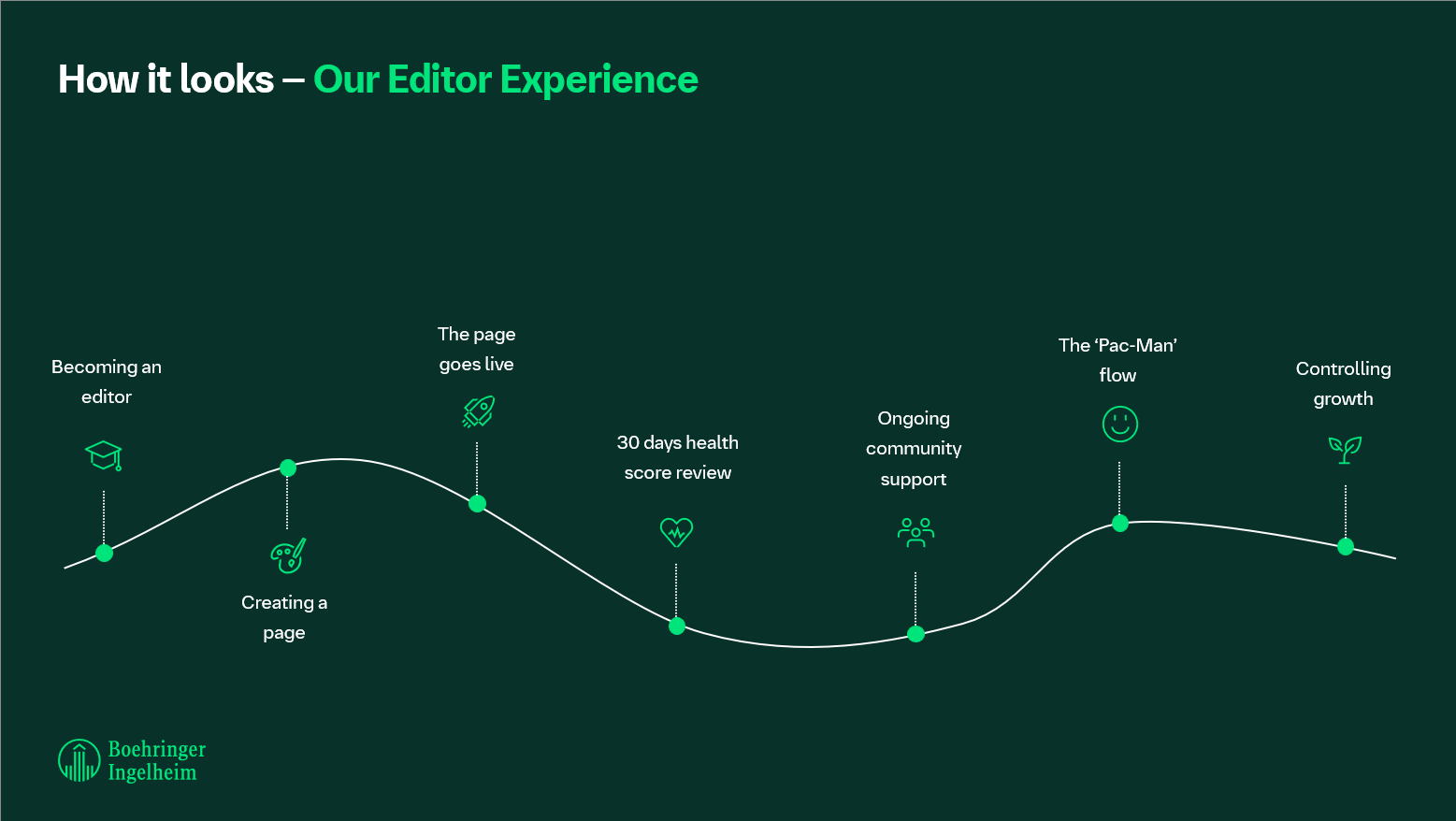
Boehringer Ingelheim’s editor experience.
Becoming an editor: training before permissions
Every editor at Boehringer Ingelheim must complete a structured online training program before they receive publishing permissions.
The training is modular and role-based:
Core modules for all editors
Additional modules for specialist roles (news publishers, events, content managers)
Clear expectations around ownership, accessibility, and quality
Editor and Content owner responsibilities include creating and updating content, acting on reminders and monitoring expiring content.
Content Manager responsibilities include coordinating lifecycle of pages and ensuring compliance is met.
“For us, training is non-negotiable,” Robert said.
“If you can publish, you must be trained. Otherwise, you risk content quality and user trust.”
Editors who complete their training then go on to receive permissions. Content managers oversee broader sections of the intranet, coordinating editors within departments and helping to manage the content lifecycle over time (including regular reviews and content expiration).
Creating a page: templates, assets, and clear standards
When an editor creates an intranet page, they’re not starting from scratch.
They are supported with:
Approved page templates
Brand aligned assets and imagery
Accessibility and style guidelines
Clear expectations around ownership and maintenance
“When you open a page, it should look and feel like Boehringer Ingelheim, not clip art or random stock photos,” Robert said.
The goal isn’t to contain creativity, but to ensure consistency, clarity and usability across tens of thousands of pages.
When the page goes live: visibility through data
Once a page is published, editors don’t work in the dark.
Editors and content managers have access to SWOOP Analytics for SharePoint intranet that shows dashboards including:
Engagement and usage
Accessibility signals
“We give editors visibility into how their content is perceived - spelling mistakes, broken links, whether people are engaging with it,” Robert said.
“It helps them self-correct instead of waiting for someone else to tell them.”
Rather than central enforcement, the data supports self-service improvement. This is a crucial capability at Boehringer Ingelheim’s scale.
The 30‑day Health Score: support, not policing
A key innovation in Boehringer Ingelheim’s governance model is a 30‑day Health Score review, powered by SWOOP Analytics.

Stefan Thormann, Corporate Brand Touchpoints Manager, Boehringer Ingelheim.
A month after a page is published:
Boehringer Ingelheim assesses its Health Score
If the score falls below 60, the editor receives a notification via Power Automate
The nudge highlights areas to improve
Importantly, the nudge is not a warning or penalty.
“We’re not sending the police,” said Stefan Thormann, Corporate Brand Touchpoints Manager at Boehringer Ingelheim.
“It’s support; ‘Here’s something you might want to improve.’
“With SWOOP, the Health Score gives editors a concrete starting point. They don’t have to guess what ‘good’ looks like.”
The process is intentionally soft touch, focused on lifting quality over time rather than enforcing compliance.
The editor community: keeping energy high
Governance at Boehringer Ingelheim doesn’t stop with rules and data. The editor community is actively nurtured.
Support includes:
Quarterly community calls
A Viva Engage community
Regular updates on Microsoft changes and new features from SWOOP Analytics
Best practice sharing and open Q&A
“The editor community is one of the most vivid communities I’ve seen,” Robert said.
“There’s energy in the calls. It never feels like ‘just another template’.”
Editors ask questions, share challenges, and learn from one another. This ensures governance becomes a shared responsibility rather than a central burden.
The “Pac‑Man” flow: managing content over time
To prevent unchecked growth, Boehringer Ingelheim built what Robert calls the “Pac‑Man” flow - a lifecycle process for ageing content. Robert came up with the name because this process “eats up” outdated content.
Pages that haven’t been updated in two years are identified automatically:
Editors and content owners receive an email notification listing the pages/News posts that are due to expire and the actions to take.
If no changes are made, a second reminder email is sent 14 days later.
If no action is taken after 30 days, the page/News post is deleted automatically, along with the related Site Assets folder.
If content is deleted, editors can restore it for a limited period (for example, within the next 30 days) if it was removed in error.
When an editor receives an expiration reminder, they have three simple options: update and republish the page (to keep it), delete it if it is no longer relevant, or take no action (in which case it will be removed automatically after the reminder period).
“We always give people the chance to take action,” Robert said.
“It’s their content. But if nobody owns it, why should it exist?”
The process is transparent, documented on the intranet, and visible to editors at all times.
Controlling growth: pruning to stay healthy
The result of this approach means rather than continuous growth, Boehringer Ingelheim’s intranet shows:
Natural content growth
Followed by periodic, deliberate pruning
Keeping total pages stable at around 30,000-35,000 intranet pages
“Without this, we’d be back at 50,000 or 60,000 pages very quickly,” Robert said.
“And we’ve been there. It was a nightmare.”
This balance keeps search usable, content discoverable, and ownership clear, even as new pages are added every day.
As Robert said, without this ongoing governance it would only be a matter of time before the intranet swelled back to 60,000+ pages.
The role of SWOOP Analytics
With such a large intranet and 2,000 editors, Boehringer Ingelheim relies on data from SWOOP Analytics to underpin governance by:
Providing objective, page‑level quality data
Surfacing issues editors can act upon themselves
Supporting conversations about “good but unused” content
Enabling scalable governance without centralised enforcement
“SWOOP gives us a way to talk about quality without opinion,” Stefan said.
“It’s not ‘we think this is bad’- it’s data directing us.”
Over time, this has helped shift behaviour across the organisation, embedding content quality as a shared responsibility.
Despite Boehringer Ingelheim being the largest intranet in SWOOP Analytics’ 2026 SharePoint Intranet benchmarking study, it’s No.1 ranking for the EMEA region and No.9 ranking in the global analysis based on Health Scores, is proof that a large intranet doesn’t have to mean chaos, provided governance is designed to support people and not fight them.
“It’s not about being the police,” Robert said.
“It’s about doing this together.”
Key takeaways
Federated governance can scale
Boehringer Ingelheim successfully supports almost 2,000 editors by combining training, data, and shared ownership rather than centralised control.
Train first, publish second
Mandatory editor training before permissions creates accountability and raises content quality across the intranet.
Data enables better behaviour
SWOOP Analytics gives editors visibility into quality, engagement, and accessibility, enabling self‑service improvement at scale.
Soft governance works
Automated Health Score nudges and lifecycle reviews with notifications from Power Automate improve quality without policing, reinforcing trust with the editor community.
Pruning sustains performance
Regular content reviews and periodic clean-ups keep the intranet stable at 30,000-35,000 pages, supporting better search, usability, and long‑term health.
